Choosing the right Acrylic Led Board from China requires more than comparing online prices. The product may look simple, yet its performance depends on acrylic quality, LED brightness, wiring, heat control, and assembly accuracy. A bright sample can still hide uneven lighting, weak edges, or poor packaging. Small details matter.
This guide explains how experienced buyers can evaluate Chinese manufacturers with greater confidence. It covers material thickness, surface finish, light distribution, color temperature, power consumption, and custom sizing. It also considers practical issues, including sample testing, production consistency, export packaging, and installation requirements. Ask for clear specifications, recent product photos, test videos, and business credentials. Independent inspections can add useful reassurance before shipment.
Reliable suppliers should communicate clearly and provide traceable quality information. Look for documented quality procedures, stable component sourcing, and realistic production timelines. Certificates can support evaluation, but they should match the actual product and market requirements. Do not rely on impressive promises alone.
Request a physical sample.
Check it in daylight and darkness. Observe the acrylic surface closely. Are the corners polished? Does the illumination remain even from different viewing angles? These checks reflect real purchasing experience, although they cannot predict every production issue. A supplier may perform well once and disappoint later. That possibility deserves attention. By combining technical review, direct communication, and careful inspection, buyers can select an Acrylic Led Board that is attractive, durable, and suitable for its intended environment.
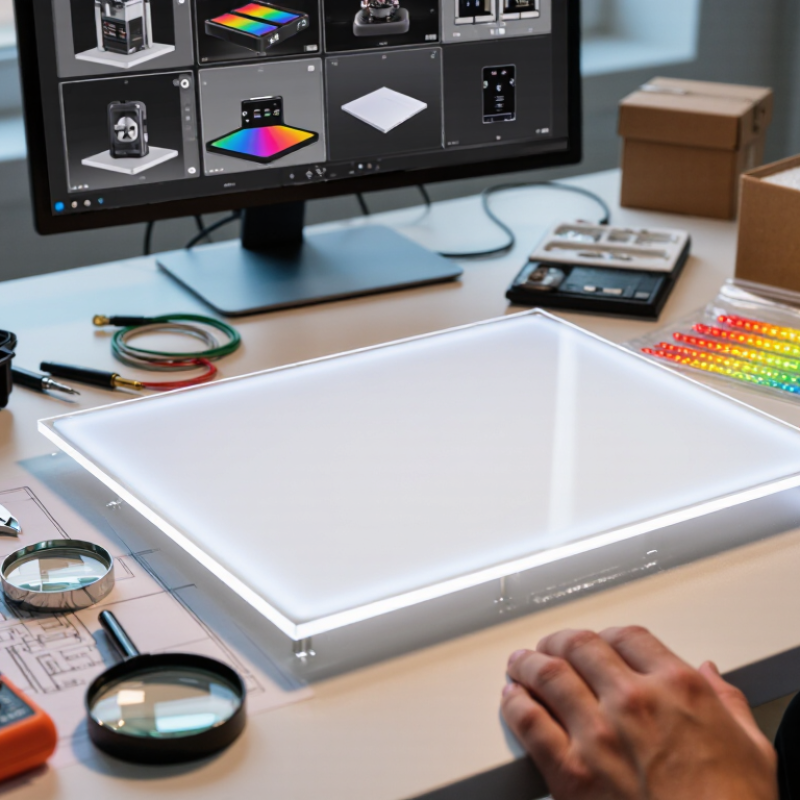
Acrylic LED boards are slim lightboxes made from clear or frosted acrylic sheets and edge-mounted LEDs. Laser-engraved or printed graphics guide light across the panel. The result is a bright, clean sign with limited depth and low visual weight. I have found them useful where wall space is tight, especially in retail counters, hotel reception areas, cafés, exhibitions, and property sales offices.
Grand View Research reported that the global LED lighting market reached about US$78.43 billion in 2023. It also forecasts an 11.2% compound annual growth rate from 2024 to 2030. This growth supports wider use of efficient illuminated signage, but it does not guarantee every acrylic board performs well. Uneven edge lighting remains a common fault. Heat, poor engraving, and weak power supplies can create dark corners or early color shifts. Some buyers focus too much on brightness. That is a mistake.
Tip: Ask Chinese suppliers for acrylic thickness, LED color tolerance, power data, and a nighttime sample video. Check viewing distance, mounting hardware, and heat dissipation. Request test photos after continuous operation. A lower price may hide thinner acrylic or inconsistent LEDs. Also confirm packaging quality; scratched panels are difficult to repair. The best choice balances light uniformity, readability, service access, and application needs.
Choosing the best acrylic LED board from China starts with measurable specifications, not attractive photos. Define the finished size, acrylic thickness, edge treatment, and mounting method before requesting quotations. For indoor signs, 3–5 mm acrylic often balances rigidity and weight. Larger panels may need a stronger frame to prevent bending. Ask whether the sheet is cast or extruded, because engraving clarity and light diffusion can differ.
Light performance needs practical testing. Specify LED color temperature, brightness, viewing distance, and illumination uniformity. Cool white may suit retail displays, while warm white can soften hospitality interiors. Request the input voltage, wattage per square meter, LED spacing, and expected service life. Also confirm whether the board is edge-lit or backlit. These designs distribute light differently. Check the diffuser, cable exit, controller, and dimming method before production.
Environmental details are easy to overlook. For outdoor use, request a stated ingress rating, sealed connections, UV-resistant acrylic, and a suitable temperature range. Ask for sample testing under real viewing conditions, not only a factory video. I once underestimated cable length, and installation became unnecessarily difficult. My brightness estimate was also too high. It looked impressive indoors but uncomfortable at close range. Require a written drawing, material data, inspection photos, and a pre-shipment sample. Confirm tolerances for dimensions, color, flatness, and alignment. Small errors become obvious on a clean acrylic surface.
How to Choose the Best Acrylic LED Board from China?
Evaluating Chinese manufacturers requires more than comparing prices. A dependable factory should explain its acrylic grade, thickness, light source, and production controls. Ask for a detailed specification sheet before discussing large orders. The sheet should identify dimensions, color consistency, power input, and expected brightness. Request a physical sample, not only polished product photographs. Photos can hide uneven edges and weak illumination.
During a sample review, inspect the acrylic under both daylight and switched-on conditions. The surface should remain smooth, without cloudy patches, scratches, or visible stress marks. Check whether the LED spacing creates dark areas across the panel. Examine cable connections and the protective backing carefully. Small details matter. Ask how workers test brightness, heat, and electrical performance. A responsible manufacturer can provide relevant test records and explain batch traceability. Production photographs or a live factory video can also reveal cleanliness and process discipline.
I once focused too heavily on appearance and overlooked packaging strength. The boards looked excellent, but one corner arrived damaged. That mistake taught me to review foam protection, carton thickness, and loading methods early. Still, no checklist removes every risk. Confirm replacement procedures, inspection timing, and communication responsibilities in writing. A clear sample approval process is more useful than a confident sales promise. Pay attention to how quickly the factory answers technical questions; vague replies often signal limited process knowledge.
Recommended evaluation priorities for comparing Chinese manufacturers and acrylic LED board quality
The weighting reflects common commercial signage procurement priorities: material quality and LED reliability should receive the greatest attention, followed by optical performance, electrical safety, customization capability, and delivery consistency. Buyers should verify each item through samples, technical datasheets, production records, and pre-shipment inspection.
Choosing an acrylic LED board from China requires more than comparing the lowest quotation. Grand View Research valued the global acrylic sheets market at about USD 4.47 billion in 2023, with continued growth expected through 2030. This demand supports many suppliers, but quality varies. For a standard 60-by-40-centimeter board, practical quotations may range from USD 18 to USD 65. Thickness, edge polishing, light diffusion, wiring, packaging, and order volume can change the price sharply. Ask for a complete cost sheet, not only a unit price.
Customization often creates hidden costs. Engraved lettering, unusual shapes, printed colors, magnetic mounting, and warm-white LEDs may require new tooling or manual finishing. A supplier may quote a low sample price, then add mold, artwork, or packaging fees. The International Energy Agency reported that LED lighting generally uses far less electricity than traditional lighting, but poor heat management can still shorten service life. Request photos of the actual edge finish and a powered sample. My own sourcing experience suggests that one sample is not enough; brightness can look uneven near corners.
Tips: Set your target size, color temperature, logo method, and packaging before requesting quotes. Compare landed cost, including freight and inspection. Confirm the MOQ in writing. A 100-unit MOQ may reduce unit price, but it can trap cash in slow-moving inventory. Start with a smaller pilot order when possible. Inspect ten random pieces, not only the first sample.
How to Choose the Best Acrylic LED Board from China?
A reliable purchase begins with documents, not attractive product photos. Ask the supplier for current certificates that match the exact acrylic LED board model. Check the testing body, report number, issue date, and electrical specifications. Certificates should cover safety, electromagnetic compatibility, and materials where required by your market. A professional supplier should explain every document clearly. If answers remain vague, treat that as a warning.
Request samples before approving bulk production. Inspect brightness across the entire panel, color consistency, acrylic thickness, edge polishing, cable quality, and heat after several hours. Test the board in a real display location, not only under showroom lighting. I once underestimated packaging strength after a perfect sample arrived. The first shipment had cracked corners. That mistake changed my inspection checklist.
Tips: Ask for sample photos beside a ruler. Confirm the acrylic tolerance in writing. Require protective film, foam corners, moisture barriers, and a strong outer carton. Request packaging photos before loading. Clarify shipping terms, production time, carton dimensions, insurance responsibility, and customs documents. Confirm whether the quoted term includes delivery to your address. Small wording differences can create unexpected costs. Leave room for inspection delays. Suppliers may promise fast dispatch, but production schedules sometimes shift.
| Category | Evaluation Criterion | Recommended Benchmark | What to Request or Verify | Selection Status |
|---|---|---|---|---|
| Acrylic Material | PMMA sheet type | Use cast or extruded acrylic according to the application. Cast acrylic generally offers better laser engraving and thickness consistency for premium signage. | Confirm the material is PMMA, not general-purpose polystyrene or PVC. Request the material specification sheet and a sample cut edge. | Preferred |
| Acrylic Material | Sheet thickness | Common signage thicknesses are 3 mm, 5 mm, 8 mm, and 10 mm. Select thickness according to board size, mounting method, and rigidity requirements. | Measure the sample with a calibrated thickness gauge at several points. Check for warping, bubbles, cracks, and uneven edges. | Check Sample |
| Optical Performance | Light transmission and diffusion | Transparent, opal, frosted, and edge-lit acrylic produce different effects. Opal or frosted surfaces generally provide more uniform illumination than clear sheets. | Test the board in a dark room using the intended LED modules, viewing distance, and power supply. Check for hotspots and dark areas. | Sample Test |
| LED System | LED color and brightness | Typical white LED color temperatures are 3000 K–3500 K for warm white, 4000 K–4500 K for neutral white, and 6000 K–6500 K for cool white. | Confirm color temperature tolerance, brightness data, LED spacing, viewing angle, and whether dimming or RGB control is required. | Match Application |
| LED System | Service life and heat management | LED modules are commonly rated around 30,000–50,000 hours under specified operating conditions. Actual life depends on temperature, current, and ventilation. | Request the LED datasheet, operating temperature range, current rating, and thermal design information. Do not rely only on an unverified lifetime claim. | Verify Datasheet |
| Electrical Safety | Power supply specification | Confirm the correct input voltage for the destination market, such as 100–240 V AC input, and the required 12 V or 24 V DC output for the LED system. | Check output voltage, rated wattage, efficiency, overload protection, short-circuit protection, grounding, and the applicable plug type. | Mandatory |
| Certifications | Market-specific compliance | For the European market, commonly requested documentation includes CE-related technical documentation and RoHS material compliance. Other markets may require different requirements. | Ask for a declaration of conformity, test reports, product-model references, and photographs of product labels. Ensure documents apply to the supplied model and power supply. | Mandatory |
| Certifications | EMC and radio-frequency requirements | LED products can generate electromagnetic interference. EMC testing may be required, while FCC requirements commonly apply to relevant products entering the United States. | Request EMC or FCC documentation where applicable and verify that the tested configuration matches the LED board, controller, and power supply being purchased. | Market Dependent |
| Product Quality | Sample approval | Approve a production-equivalent sample before mass production. The sample should use the same acrylic grade, LED modules, wiring, controller, and packaging method. | Record dimensions, color, brightness, power consumption, mounting holes, cable length, surface finish, and acceptable defect limits in the purchase order. | Mandatory |
| Quality Control | Inspection before shipment | Use a documented inspection covering appearance, dimensions, illumination uniformity, electrical safety, quantity, accessories, and packaging condition. | Request inspection photographs, test records, carton counts, serial or batch references, and a corrective-action process for nonconforming goods. | Recommended |
| Packaging | Individual and inner protection | Each acrylic board should be protected with a removable film or suitable surface protection, then separated with foam, cardboard, or another non-abrasive material. | Confirm that corners, engraved surfaces, cables, power supplies, and controllers are separately protected against scratches and impact. | Mandatory |
| Packaging | Export carton and palletization | Use strong corrugated cartons with internal cushioning. For large, heavy, or multi-carton shipments, palletization and corner protection reduce handling damage. | Check carton dimensions, gross and net weight, stacking limits, moisture protection, carton markings, and whether wooden pallets comply with ISPM 15 when required. | Confirm Before Order |
| Shipping Terms | Incoterms and cost responsibility | Common options include EXW, FOB, CIF, and DAP. Each term allocates different responsibilities for export clearance, freight, insurance, import clearance, duties, and final delivery. | State the named place or port and the applicable Incoterms rule and version in the quotation and purchase contract. Compare total landed cost, not only product price. | Mandatory |
| Shipping Terms | Transport mode and lead time | Air freight is generally faster but more expensive; sea freight is generally more economical for larger volumes. Production time must be added to transit time. | Request separate estimates for production, inspection, export handling, transit, customs clearance, and final delivery. Confirm the shipment cut-off date. | Compare Options |
| Commercial Terms | Warranty and after-sales support | Obtain a written warranty covering acrylic defects, LED failure, power-supply failure, workmanship, and replacement or compensation procedures. | Clarify warranty duration, exclusions, evidence requirements, spare-parts availability, response time, and responsibility for shipping defective components. | Mandatory |
| Final Decision | Supplier comparison method | Select the offer with the best combination of verified compliance, sample quality, durability, packaging protection, delivery reliability, and landed cost. | Use the same specification sheet and scoring criteria for every quotation. Keep the approved sample and signed technical documents as the production reference. | Best Practice |
It is a slim lightbox made from clear or frosted acrylic. Edge-mounted LEDs illuminate engraved or printed graphics. The panel stays bright without much wall depth.
They suit retail counters, hotel reception desks, cafés, exhibitions, and property sales offices. They work well where wall space is limited.
Uneven LED spacing can create dark areas. Poor engraving, weak power supplies, and heat may also reduce uniformity. Brightness alone does not prove quality.
Ask for acrylic thickness, material grade, dimensions, LED color tolerance, power input, and brightness data. Request heat-dissipation details and mounting information.
Yes. Product photos can hide cloudy patches and uneven lighting. Inspect the sample in daylight and when switched on. Samples matter.
Check for scratches, stress marks, loose cables, and dark sections. Request a nighttime video and test photos after continuous operation. Examine the protective backing carefully.
Review foam protection, carton thickness, and loading methods. Acrylic scratches and damaged corners are difficult to repair. Packaging deserves attention.
Not always. A low price may reflect thinner acrylic or inconsistent LEDs. Compare uniformity, readability, service access, and protection before deciding.
Request test records, batch traceability, production photos, and a live factory video. Clear answers to technical questions suggest stronger process knowledge. I once focused too much on appearance and missed packaging strength.
Choosing the right Acrylic Led Board from China begins with understanding its structure, lighting performance, and intended application, such as retail signs, interior decoration, exhibitions, or commercial displays. Buyers should compare key specifications including size, thickness, LED brightness, color temperature, power consumption, viewing effect, and expected service life. These details help ensure the board matches both the visual design and installation environment.
A reliable purchasing process also requires careful evaluation of Chinese manufacturers, including production experience, quality-control procedures, material consistency, and communication ability. Compare quotations by considering customization options, minimum order quantities, tooling costs, and production schedules rather than focusing only on the lowest price. Before placing an order, request samples and verify relevant certifications, inspection documents, packaging quality, and shipping terms. Clear agreements on product details, delivery responsibilities, payment arrangements, and after-sales support can reduce misunderstandings and help ensure that the final Acrylic Led Board arrives safely and performs as expected.

Kexian